- All e-books and audiobooks on The New Life Mission website are free
- Explore multilingual sermons in global languages
- Two new revised editions in English have been released
- Check out our website translated into 27 languages

Due to COVID-19 and disruption to international mail service
we have temporally suspended our ‘Free Print Book service’.
In the light of this situation we are not able to mail you the books at this time.
Pray that this pandemic will end soon and the resumption of the postal service.
Pray that this pandemic will end soon and the resumption of the postal service.


Beyond the Nicene Creed: Restoring the True Gospel of the Water and the Spirit
- Loren Simons
- United Kingdom
- 05/04/2026
- 351
English 69
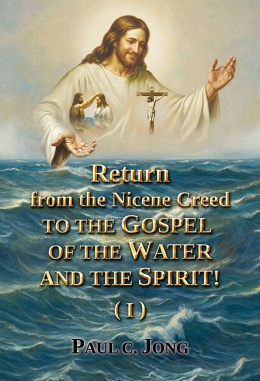
Return from the Nicene Creed to the Gospel of the Water and the Spirit! (I)- ISBN9788928262229
- Pages540
- Rate
Hello.
Here is my review of the Book titled, `Return from the Nicene Creed to the Gospel of the Water and the Spirit (I)` by Reverend Paul C. Jong.
I became aware of how little I know about the origins of religious traditions and theological frameworks after reading this book and how nothing can be regarded as true if it does not start with the Word of God.
Luckily for me, this book walks the reader through history beginning with the baptism of Jesus, where He received the sins of the world, the Cross, His resurrection, the faith of the apostles and the early church fathers and then the Nicene Creed, which subsequently has altered the faith of mainstream Christianity today by removing the baptism of Jesus.
The Nicene Creed was formed in AD 325 by Emperor Constantine to unify the Christian faith of the Roman Empire. One of the reasons the Creed was founded was to combat the beliefs of the Macedonians who denied the Holy Spirit`s divinity, as well as the Arian controversy, which questioned the divinity of Jesus in relation to God the Father. The baptism of Jesus, which is essential to our salvation, is entirely absent from the Creed, despite its historical significance as a standard of faith that founded Trinitarian theology, which holds that the Triune God is One. Because mainstream Christianity does not preach the mystery of Jesus` baptism, we now have fragmented denominations that adhere to customs and sacraments, such as the Catholic Church, whose leaders and followers are bound by sin.
The Edict of Milan in AD 313 legalised Christianity and prompted the need for the Nicene Creed years later. The legalisation of Christianity meant that believers no longer suffered persecution within the Roman Empire, allowing them to freely practise their faith. But the church lost the pure faith because of this newfound freedom, a faith that had long been preserved and strengthened through martyrdoms and sufferings. The faith became diluted, and what remained were Catholic doctrines headed by Constantine, and a new Catholic religion emerged under this state power. The Roman Emperor became the head of the Church, and the Church then became a church belonging to the Roman Empire.
Introducing another historical event, the author explores the discovery of the Didache records in 1873 by a monk of Constantinople. `Didache` means `teaching` in Greek. This teaching manual was written approximately between 70 and 120 AD and is a practical guidebook on how the Church lived out its faith in the gospel preached and taught by the apostles. This includes regulations for patterns of worship, baptisms, offerings and the manner of appointing bishops and deacons within the Church. An example of this was the teaching that baptism should be administered in the name of the Holy Trinity and performed in running water where possible. This historical guidebook details how the apostles practically carried out their life of faith, and whilst the Didache records contain guidance for everyday living, it does not reveal the complete gospel of redemption needed for salvation found in the Bible.
What I found intriguing in Sermon 3 was the author`s comparison of how little we know and continue to learn about space and the universe to how little we know about God, His plan of salvation and our nature as human beings. The universe is continually being studied through the lens of science, but it is so vast that we are still discovering new information. Similarly, we cannot even begin to understand God and His Word without approaching it through the lens of faith. We are nothing. The galaxies and expanse of space show us just how insignificant we are in the bigger picture.
Nevertheless, God came to save such sinful and insignificant creatures as us. We should be humble and listen to all that God says. If God says that we are born in sin and can only produce the fruit of sin, then we should just agree.
"For all have sinned and fall short of the glory of God" (Romans 3:23).
If God says that the only way to see and enter the Kingdom of God is to be born again of water and the Spirit (John 3:3-5), then we should just accept and say, `Yes, God, I believe everything you say is true,` even if we don`t fully comprehend it.
The Early Church`s faith preached Jesus` baptism and the Cross. However, once the apostles were martyred and the Church Father`s era began, the baptism of Jesus was changed into a ritual. The Catholic Church initiated baptism for its believers as a method of removing original sin. This method failed to deliver the true meaning of Jesus` baptism. Therefore, baptism became a symbol and not the very act we must believe in to be saved.
Today, Christianity is trapped in a cycle of repentance, piousness, and prayers of repentance. Similarly, all religions are the same, telling their followers: carry out good deeds, and you will eventually become sanctified. They all encourage self-reliance while neglecting the power of Jesus.
Peter`s faith was wholly reliant on Jesus. That is why he confessed: "You are the Christ, the Son of the living God" (Matthew 16:16). This confession is not only for Peter and the disciples during that time but also for us at present. The Word of God is not just moral lessons of life but actual life-giving words of salvation. Such faith denies one`s own thoughts and looks to the Word as the absolute truth above all else.
Reformers such as Luther, Calvin, and Zwingli attempted to reject the Catholic church and the Pope`s authority in the 16th century. Although the essence of the Reformation is somewhat separated from the Catholic Church, their beliefs remain centred on the blood-only faith established at the Nicene Creed. Subsequently, Christianity formed by the Reformers, called Protestantism, still believes in an incomplete gospel. They may not acknowledge the hierarchy of the Pope and Catholicism, but they have not truly undergone reform since they preach a gospel that is incapable of eradicating sin from the heart.
The author poses a question, asking, `What losses must contemporary Christianity endure to return to the gospel of the water and the Spirit?`
The answer is a huge loss. It would mean turning their back on all the theological knowledge and sacraments that are plaguing Christianity today. This includes their take on all existing doctrines as well as their certificates and diplomas related to all their teachings. In other words, a complete redo of everything they have known and believed thus far. This may cause others to look down on them, and they may feel ashamed and embarrassed, but ultimately it will save their soul and the souls of others if they repent and return to the original gospel of the water and the Spirit.
Systems and structures will also collapse, but what will be reborn, along with their spirit, is a church of God, centred on God`s Word. They may lose all these things, be ostracised from society, family and friends and have nothing left, but they would have gained Christ. So, we should all carefully consider our end.
"For whoever desires to save his life will lose it, but whoever loses his life for My sake will find it" (Matthew 16:25).
"Yet indeed I also count all things loss for the excellence of the knowledge of Christ Jesus my Lord, for whom I have suffered the loss of all things, and count them as rubbish, that I may gain Christ" (Philippians 3:8).
In summary, the Council of Nicaea solidified the divinity of Jesus and the Holy Trinity. The faith of the Arians, Macedonians, and everyone else who opposed the Holy Trinity faith was declared to be heretical by the Council. Controversy followed this ruling in 325, and thereafter another council was held in Constantinople in 381, further confirming the role and status of the Holy Trinity. The Nicene Creed tells us who Jesus is, but it is silent on how Jesus took on the sins of the world through His baptism.
The victory of the Creed protected the Early church from losing the roots of the gospel.
But unfortunately, the result is that Christianity now has no power in preaching the gospel of redemption because the baptism of Jesus has been removed and it does not lead its followers to the baptism of Jesus, where the transference of sin took place.
This book is an exhortation to return from the Nicene Creed to the Gospel of the Water and the Spirit, which the Apostles taught the Early Church. May this book do just that for you, and may you live a blessed new life, "looking unto Jesus, the author and finisher of our faith" (Hebrews 12:2).
Amen

