English 69
Return from the Nicene Creed to the Gospel of the Water and the Spirit! (I)Rev. Paul C. Jong
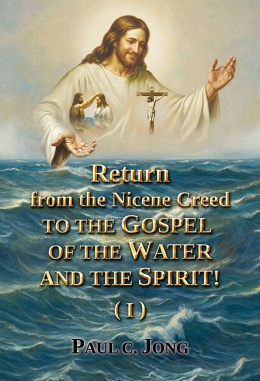
While reading the newly published book by Rev. Paul C. Jong, "RETURN FROM THE NICENE CREED TO THE GOSPEL OF THE WATER AND THE SPIRIT," I realized that humanity has always sought two things: simplicity and longevity.
With the rapid advancement of science and technology, man has arguably achieved the desire for a simpler life. However, we have failed terribly in our quest to conquer aging and death. Why? Because such wisdom cannot be found within humans or even angels; it belongs only to the Almighty Creator. Therefore, it is wise for us to listen to the Word of God, for out of it flow rivers of living water.
Matthew 7:13-14 records: “Enter through the narrow gate. For wide is the gate and broad is the road that leads to destruction, and many enter through it. But small is the gate and narrow the road that leads to life, and only a few find it.” This scripture is an admonishment to anyone seeking a Christian life. The Bible tells us to enter the narrow gate that leads to life, rather than the wide gate that leads to destruction.
It is human nature to prefer the easy path over the difficult one. Man will always look for a shortcut. Although God decreed that man would eat by the sweat of his brow, today we have built machinery to work on our behalf. While using technology to ease our physical labor is practical, it is dangerous to "twist" the Word of God to make it "easier" for our own convenience. When it comes to God`s Word, we must accept it exactly as it is—nothing more, nothing less.
Rev. Paul C. Jong’s book enlightened me regarding the Edict of Milan by Constantine and the subsequent Seven Sacraments. Before the Nicene Creed was implemented, during the Apostolic age, a person was recognized as a true Christian only when they fully acknowledged the Gospel of the Water and the Spirit. This Gospel tells us how Jesus shouldered the sins of the world through His baptism, died on the Cross as a ransom for those sins, and resurrected on the third day for the redemption of mankind.
When the Apostles chose a replacement for Judas Iscariot, the Bible records they sought someone who had been with them “beginning from John’s baptism to the time when Jesus was taken up from us” (Acts 1:21-22). This implies more than just physical presence; it refers to someone who had spiritual faith in the work of Jesus Christ, starting from His baptism (the shouldering of sin) to His death (the ransom) and His resurrection (redemption).
However, this requirement was discarded after the Edict of Milan. The Nicene Creed reduced this order by focusing only on Christ as the Savior who died and rose, bypassing His baptism. By human standards, this might not seem like a big deal, but by God’s standards, the difference is as far as the heavens are from the earth.
To illustrate what the Nicene Creed did to human faith, consider this story: Two psychiatric patients wanted to be discharged. The doctor gave them a test: "Mop all the water out of this sink, and I will let you go." They mopped with passion all day, but the sink remained full because they failed to realize the tap was still running. Desperate, they planned to escape by attacking the gatekeeper at the gate. But when they reached the gate, it was wide open and no one was there. Instead of leaving, they were confused and went back to their rooms, saying, "Our plan is ruined; let`s wait until tomorrow when the gate is closed so we can escape as planned." Because their minds were not well, they couldn`t accept a reality that differed from their own flawed plan.
This is exactly what the Nicene Creed has done. By omitting the relevance of Jesus’ baptism to salvation, it "caged" people. Since the part where Jesus shouldered our sins was removed, it was replaced with "prayers of repentance," which can never truly wash away sin or grant a clean conscience. Those who cling to this faith—believing Jesus died for them but thinking they must constantly offer prayers for daily forgiveness—eventually grow weary. It is an endless cycle, like the patients mopping a sink with an open tap.
Many are tired of this incomplete faith and want to escape. The true escape plan is the Gospel of the Water and the Spirit. It sounds almost too good to be true, but it is the truth: Jesus took away your sins—past, present, and future—at the Jordan River when John the Baptist laid hands on Him (baptism). He then died on the Cross for those sins and rose again.
Apart from the Gospel of the Water and the Spirit, there is no other way to escape the "cage" of the Nicene Creed. This Gospel is the narrow path to life. I thank God for giving Rev. Paul C. Jong the power to preach this truth as it was preached in the Apostolic time. His writings are pure, biblical, and Spirit-filled.
Some might think Rev. Jong is complicating salvation by emphasizing the baptism of Jesus alongside His blood. They prefer the "simplicity" of just calling on His name. But if they listen with an open heart, they will realize that Jesus saved us not just with His blood, but through both the water of His baptism and His blood on the Cross. Let us all return from the Nicene Creed to the Gospel of the Water and the Spirit.

Copyright © 2021 by The New Life Mission


